History of Comparative Literature
Origins: 1946–1949
The journal Comparative Literature (CL) traces its origins to a luncheon in Princeton in 1946, where Chandler B. Beall and Werner P. Friederich were guests of Gilbert Chinard. At the time, Friederich was campaigning for a Comparative Literature Section on the Modern Language Association (MLA) program, organizing committees, publishing a CL Newsletter, compiling a basic bibliography, and laying the groundwork for what would become the Yearbook of Comparative and General Literature. The French Revue de littérature comparée (RLC), the discipline’s longstanding European flagship, had not yet revived after its collapse during the German occupation, and American scholars felt the need for a comparable journal to serve as the official outlet of the new MLA section.
Beall, then teaching at Princeton, proposed that a journal be sponsored at his home institution, the University of Oregon. In September 1947 he made a formal proposal to Oregon’s president, Harry K. Newburn. President Newburn was not himself a literary scholar, but recognized the prestige a scholarly journal would bring to the campus. In a letter of November 13, 1947, Newburn agreed to finance the undertaking for a trial period of three years, on three conditions: that the University of Oregon would retain full ownership and direction, that an Editorial Board would be created representing MLA comparatists, and that Beall would serve as Editor. Correspondence between Beall and University Editor George N. Belknap during this founding period shows the practical work of establishing the journal—securing manuscripts, negotiating budgets (the original allocation was $2,000, intended to cover printing alone), and acquiring the typographical equipment needed to print French, German, Spanish, and Italian text.
The first members of the Editorial Board were appointed by President Newburn in March 1948: Werner P. Friederich (University of North Carolina) as Associate Editor, with board members Helmut Hatzfeld (Catholic University of America), Victor Lange (Cornell), Harry Levin (Harvard), Austin Warren (University of Michigan/Iowa), and René Wellek (Yale). Notably, four of the seven founding editorial staff were European émigrés—Friederich, Lange, Hatzfeld, and Wellek—reflecting the wave of refugee scholars who had reshaped American literary studies after the rise of fascism in Europe.
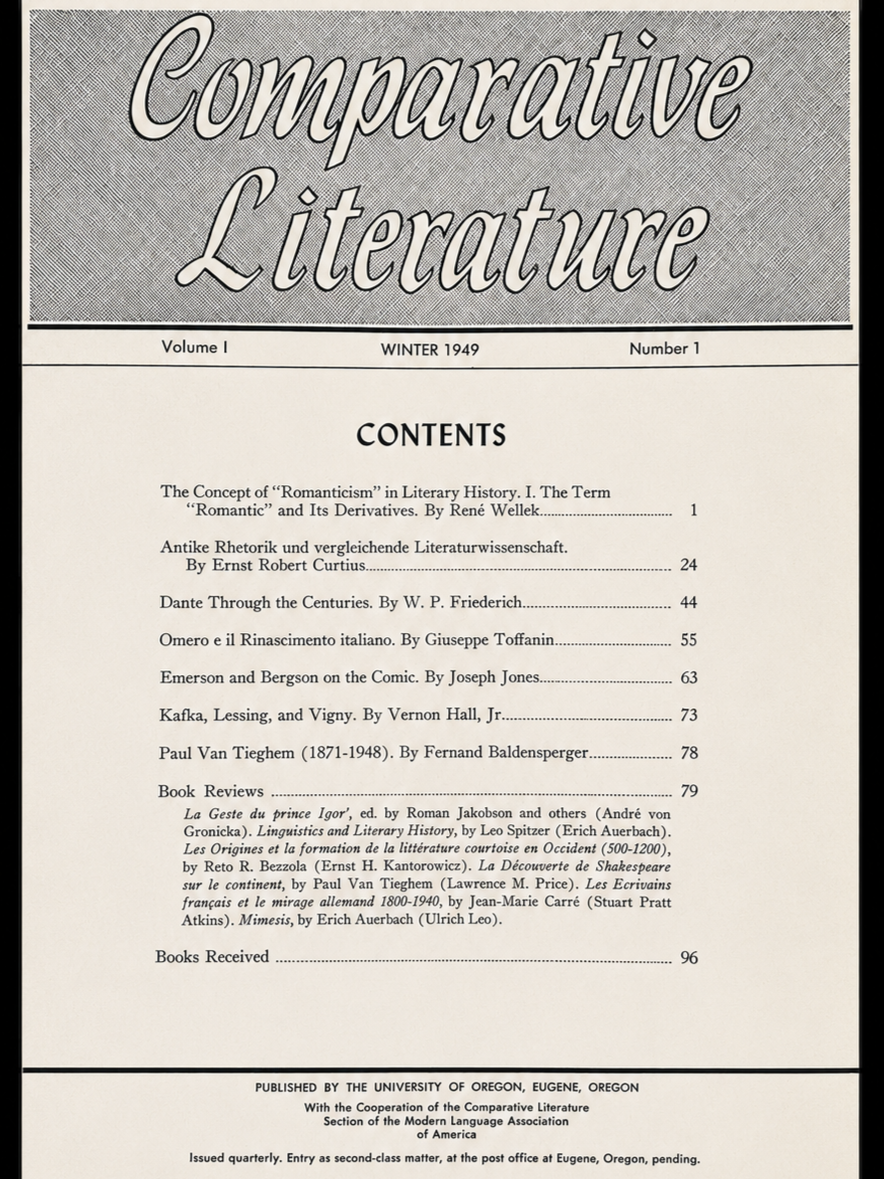
The first issue of Comparative Literature appeared in spring 1949, published quarterly by the University of Oregon “with the cooperation of the Comparative Literature Section of the Modern Language Association of America.” Early issues carried significant contributions, including an article by Wellek and a piece by Erich Auerbach drawn from his then-recently translated Mimesis. The journal also reviewed Auerbach’s and Leo Spitzer’s work, signaling its alignment with the emerging New Criticism and European philological scholarship. A 1950 confidential progress report to the Publications Committee recorded that in its first year and a half CL received 154 article submissions, accepted 52, and rejected 96, establishing a pattern of selectivity that would persist throughout the journal’s history. The report also noted enthusiastic letters from scholars across the United States and abroad, including Benedetto Croce, Fernand Baldensperger, Marcel Bataillon, and Américo Castro, praising the journal’s scholarly seriousness and its arrival as a much-needed venue.
The Beall Years and Institutional Growth: 1949–1972
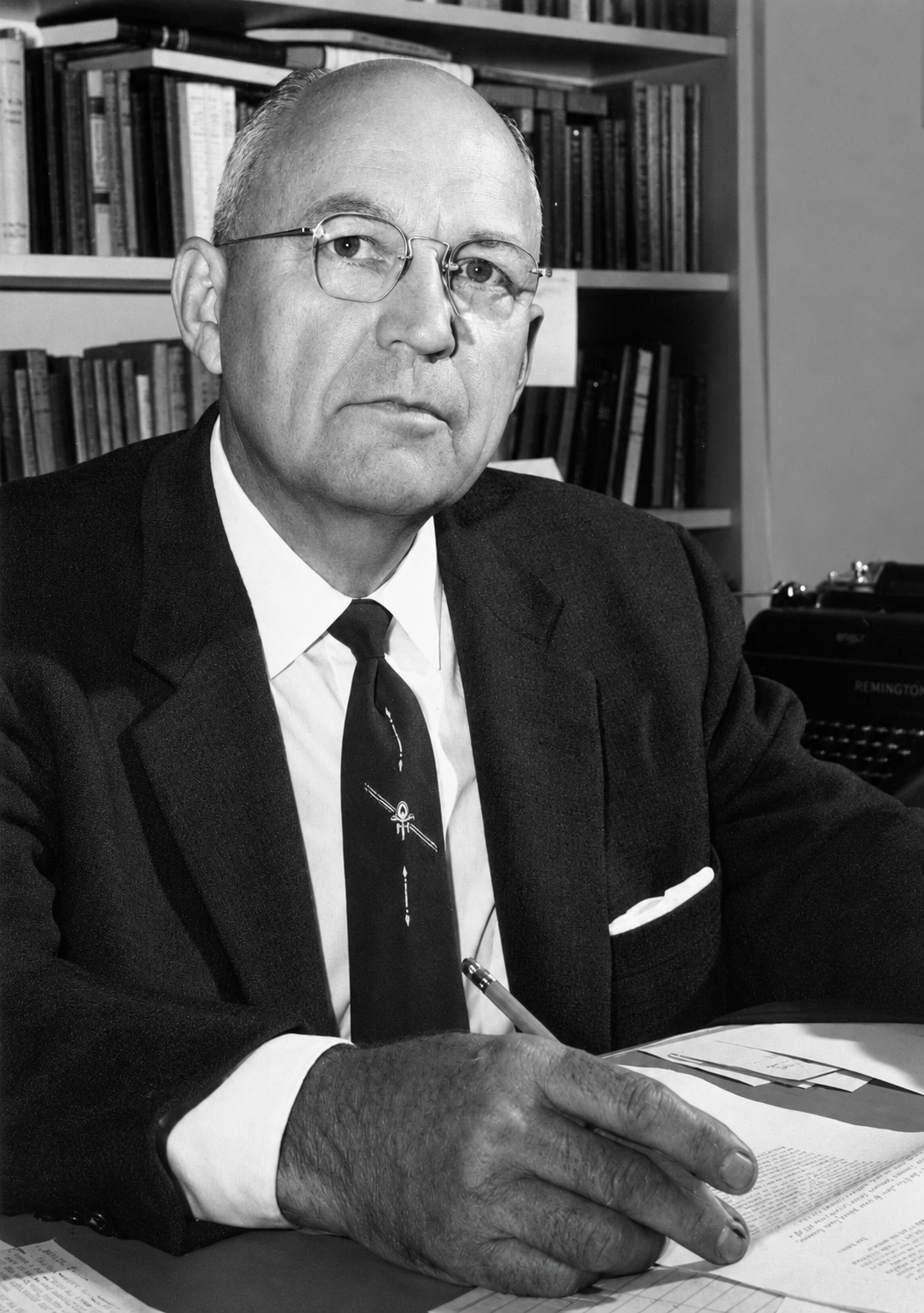
Chandler Beall edited Comparative Literature for some 23 years, from its founding until his retirement in 1972 (some sources note 25 years total, counting through emeritus involvement). Under his editorship the journal grew from a regional experiment into an internationally recognized publication. By the mid-1960s, CL was mailed to scholars and libraries in every state of the Union and in roughly 50 foreign countries, including nations behind the Iron Curtain—Bulgaria, Czechoslovakia, East Germany, Hungary, Poland, Romania, the Soviet Union, and Cuba. Beall’s report to colleagues noted that CL research, while still centered on Western Europe and the United States, was drawing growing interest from the British Commonwealth, Japan, India, Egypt, and Latin America.
In celebration of its first decade, CL redesigned its cover and format and published a comprehensive ten-year cumulative index, distributed to roughly 10,000 libraries and scholars worldwide. Beall described the journal’s implicit thesis as the conviction that, despite barriers of language and nationality, literatures share a common heritage of themes and forms—a “one world” view of literary history that increasingly emphasized critical evaluation over source-hunting and “comparison for comparison’s sake,” a phrase Beall used repeatedly to describe the kind of superficial parallel-hunting he most disliked.
The Editorial Board saw some turnover during these years—the seat originally held by Austin Warren passed to Francis Fergusson, then Mark Schorer, and then Bernard Weinberg—but the founding nucleus remained remarkably stable. Beall himself maintained close, often contentious correspondence with board members, especially Friederich and Wellek, over editorial philosophy. A notable exchange in 1952 found Wellek and Friederich disagreeing sharply over how strictly “comparative” a submission needed to be, with Wellek favoring a broader inclusion of general literary theory. This tension between a narrow philological definition of comparative literature and a broader theoretical one would persist throughout the discipline’s history.
Beall also built a graduate program in Comparative Literature at Oregon, formally approved by the graduate school in April 1962, drawing on faculty from both English and foreign-language departments and eventually supported by National Defense Education Act (NDEA) fellowships beginning in 1963. He recruited European émigré scholars onto the journal’s staff and was deeply influenced by Wellek and Warren’s Theory of Literature (1949), which he considered the single most important catalyst for the shift in American graduate study away from positivistic literary history and toward criticism.
Editorial Succession
Beall died on August 21, 1993, after a long retirement during which he remained closely engaged with the journal’s direction. His successor as editor, Thomas R. Hart, succeeded him in 1972. In an obituary co-written with Steven F. Rendall, Hart recalled that Beall never accepted a rigid, narrow conception of comparative literature, that he was skeptical of “comparison for comparison’s sake,” and that he devoted enormous personal energy to copyediting manuscripts so that CL’s prose would be lucid as well as scholarly.
Hart’s own path to the editorship illustrates how thoroughly comparative literature as an American discipline had been shaped by mid-century émigré scholarship: trained at Yale under René Wellek, with mentors including Erich Auerbach, Henri Peyre, and Leo Spitzer, Hart came to Oregon in 1964 at Gregor Sebba’s recommendation and was understood from the start to be Beall’s eventual successor. Hart edited CL from 1972 until his retirement in 1990, after which he continued to edit the journal one quarter each academic year, by his own account until 1995.
Under Hart, the journal’s editorial process became more formalized: roughly one in five submitted manuscripts was forwarded to the Editorial Board for full review, of which about a third were accepted, meaning that, overall, only a small fraction of submissions reached publication. Hart noted that the kinds of articles published had shifted over the decades: the early years’ frequent état présent essays and Forschungsberichte (state-of-the-field surveys) had become rare, while explicit engagement with literary theory had grown, even as some major late-twentieth-century developments—deconstruction and the New Historicism among them—remained only lightly represented in the journal’s pages, in part because they did not fit easily within a discipline still organized around relationships between texts.
Later editorial leadership passed to Steven Rendall and eventually George Rowe whose tenure coincided with the rise of postcolonial criticism, translation theory, and the emergence of world literature as a major framework for literary scholarship. Today, the editorship continues under Michael Allan, whose scholarship on colonial archives and media theory reflects the transformation of comparative literature over the last several decades. The journal that once emerged from debates about European philology and literary influence studies now serves as a leading venue for scholarship on decolonial studies, visual culture, translation theory, and comparative methodologies extending far beyond traditional literary boundaries.
Contemporary Significance
Comparative Literature’s founding reflects a specific historical moment: the postwar reconstruction of literary scholarship in the wake of the RLC’s wartime collapse, the influx of European émigré scholars fleeing fascism, and the consolidation of comparative literature as a distinct field within American universities and the MLA. Its editorial history—visible in the institutional correspondence between Beall, Belknap, Friederich, and Wellek—also documents an enduring methodological debate within the discipline: how narrowly “comparative” research needed to be, and whether the field’s center of gravity lay in demonstrable textual influence or in a broader history of ideas and criticism. The journal’s longevity under just three editors across more than four decades (Beall, then Hart, with Rendall closely associated) gave it unusual institutional continuity, and its circulation—reaching dozens of countries on both sides of the Cold War divide—made it one of the principal vehicles through which comparative literature became an internationally recognized scholarly discipline rather than a regional American experiment.